
Welcome to The India Fix by Shoaib Daniyal. A newsletter on Indian politics.
As always, if you’ve been sent this newsletter and like it, to get it in your inbox every week, sign up here (click on “follow”).
In 2021, the Sweden-based V-Dem Institute released a report that for the first time described India, not as a democracy, but as an electoral autocracy. An electoral autocracy, in V-Dem’s definition, is a country where multi-party elections exist – but are flawed. In addition, the state places significant restrictions on freedom of speech and press independence.
Notably, V-Dem held that while the fairness of elections was “hard hit”, it is the diminishing of these liberal aspects of democracy that have gone the “furthest” when it came to turning Modi’s India into an electoral autocracy in its data set.
Five years later, as the state of West Bengal goes to polls, it is clear that Modi’s India has now balanced these two elements: the conduct of elections has also taken a significant hit.
Illogical discrepancies
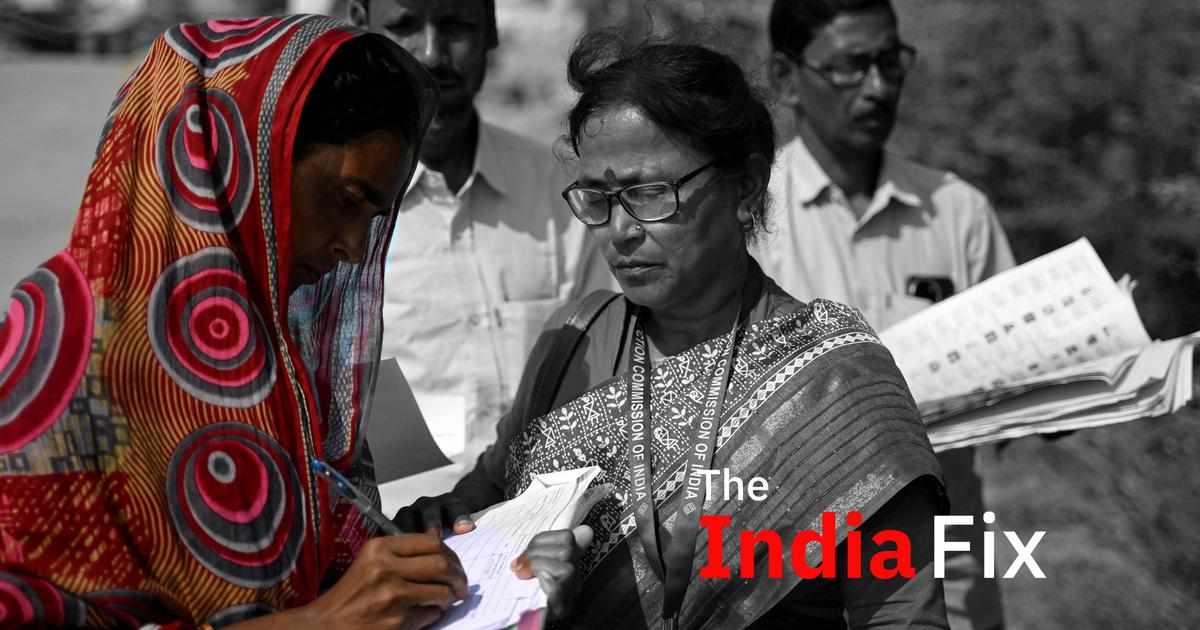
Just before the elections, the Election Commission of India carried out a special intensive revision in the state. Attempting to verify the existence of each voter, this exercise was massive and conducted at a scale never seen before in independent India. Even before it started, doubts were raised about why such an extensive exercise was to be carried out just before the elections. This itself came against the backdrop of fears that the Election Commission was under the thumb of the Modi government, after a new law put the Union government in charge of appointing election commissioners.
Despite these doubts, the first phase of the special intensive revision in West Bengal was conducted using a fairly robust methodology. The Election Commission mapped voters to the 2002 voter list to find out who had died, moved or had a voter ID card in other states.
The only problem: this objective methodology ended up removing a very large number of people who would normally vote for the Bharatiya Janata Party. The process of mapping to the 2002 voter list meant that many Bangladeshi Hindu migrants as well as migrants from Uttar Pradesh and Bihar were excluded.
After this, the Election Commission did something remarkable. It invented a so-called logical discrepancies test specifically for West Bengal – it had not been used in other states before. Ironically, there seemed to be very little that was logical about this test. Spelling errors in parents’ names, having an age difference with one’s parents that is deemed too small or large, not having a big enough age gap with one’s grandparents or having more than six children were all deemed to be so-called logical discrepancies by the Election Commission.
The Commission never explained the logic behind why having a certain number of children or spelling mistakes in one’s documents made one ineligible to vote.
Worse, this logical discrepancies test was applied using an opaque artificial intelligence software whose workings were not open to the Indian public.
Removing non-BJP voters
The result of this new filter by the Election Commission was remarkable: the special intensive revision now excluded nearly three million voters, most of whom were Muslim. All evidence produced till now shows that these exclusions had little logic and seemed to be based on only criteria: religion. In one case, a tribunal reversed the exclusion of a Congress candidate, Motab Shaikh, while noting, remarkably, that the Election Commission was unable to provide a reason for why he was deleted in the first place.
Given that almost all these unfairly excluded voters are Muslim, who tend not to vote BJP, the Hindutva party heads into the West Bengal polls with an unfair but significant advantage provided by the Election Commission.
As V-Dem noted, much of India’s democratic decline was predicated on the idea that its liberal institutions were being hobbled. Most notably, the courts have been unable to hold the government accountable. The press is in sharp decline. For years now, mainstream TV news channels and even newspapers have taken to lauding the government and reserving all criticism for the out-of-of power Opposition.
Bypassing elections
The hold on these institutions is so strong that although the BJP was given a sharp rebuke by voters in 2024, with the party losing its majority in Parliament, this seems to have made no difference to the power it wields in Delhi.
Now the BJP is trying to make sure that a 2024-style electoral rebuke does not happen again. The Bengal special intensive revision is a major step in that direction. If the Modi government-appointed Election Commission can simply, without any explanation, delete millions of Opposition voters, what do elections mean in India going forward?
The Bengal result will, in many ways, decide the fate of Indian electoral democracy going forward. If the BJP wins the state, there is little stopping it from trying these mass deletions in other states and, eventually, in the 2029 Parliamentary elections.
“What Bengal thinks today, India thinks tomorrow,” the colonial-era Indian politician, Gopal Krishna Gokhale, is supposed to have declared. It was a line meant to laud Bengal’s progress within British India.
If the Election Commission’s mass deletions succeed in bringing the BJP to power in West Bengal, the line might still hold – but in a much darker shade of meaning.



Write a comment ...