Welcome to The India Fix by Shoaib Daniyal. A newsletter on Indian politics.
As always, if you’ve been sent this newsletter and like it, to get it in your inbox every week, sign up here (click on “follow”).
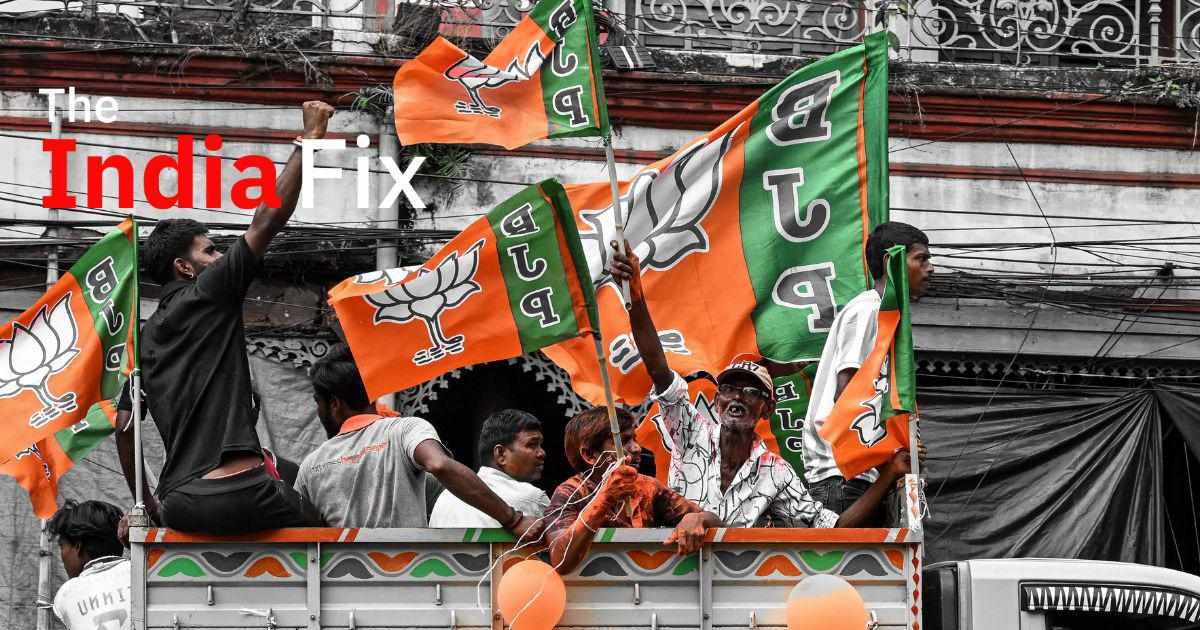
The state election results declared on May 4 offer an insight into Indian politics two years after the Bharatiya Janata Party returned to power at the Centre with a significantly weakened mandate.
In an interview with Scroll, political analyst and psephologist Sanjay Kumar of the Centre for the Study of Developing Societies, said that the Opposition alliance stands significantly weakened: the BJP ousted the Trinamool Congress from West Bengal and the Dravida Munnetra Kazhagam lost Tamil Nadu to actor Vijay’s Tamilaga Vettri Kazhagam. However, the Congress managed to win Kerala with a big majority.
There was talk of MK Stalin of the Dravida Munnetra Kazhagam or Mamata Banerjee of the Trinamool Congress leading the INDIA bloc, said Kumar. “Now, after both of them being defeated, this discussion will be paused,” he said. “There is no challenge to Rahul Gandhi’s leadership within the INDIA alliance, though it is weaker now.”
For the BJP, this is a moment of extra happiness because INDIA partners are losing state after state, said Kumar. “A major resistance to the BJP was from Mamata Banerjee in West Bengal and also from Stalin in Tamil Nadu,” he said. “Both states had sent a large number of MPs from the INDIA bloc.”
Even otherwise, the BJP has been just as aggressive in its third term. “They are trying to send out a message that they are not worried about the numbers even though they do not have a majority government,” said Kumar. “[Their message is] that they will try and fulfill promises like when they were in a majority in 2019 or 2014.”
Edited excerpts:
How do you unpack what has been a really big week for Indian politics? Is there one message that you are getting out of these five election results?
It is difficult to say, but one big message is clear: If the government works, there is a possibility of it coming back to power – like Assam and Puducherry.
And if people are not satisfied with the work done by the incumbent government, they are ready to throw you out. And I am referring to the three states where the incumbent governments lost elections: West Bengal, Tamil Nadu and Kerala.
So anti-incumbency is a factor in Indian politics, but it’s not a blind factor?
Anti-incumbency is not a by-product of any government being in power for five years. There are many governments in India which have been in power for many, many years.
I am referring to Gujarat. Now Assam, third time in a row. In West Bengal, the Left ruled for 34 years. After that, Trinamool Congress ruled for 15 years. In Odisha, BJD [Biju Janata Dal] ruled for 25 years. And don’t forget Sikkim, where the Sikkim Democratic Front government was there for 25 years.
Anti-incumbency is a byproduct of people’s unhappiness with the work done by the incumbent government.
In this election, you can clearly see that there was some degree of anti-incumbency in the three states and pro-incumbency in the two states. And that is one of the core factors why we see two governments returning to power and three governments being voted out of power.
I would like to cite data. The vote share of the Trinamool Congress in West Bengal has declined by 8.5% compared to the 2021 election.
In Tamil Nadu, DMK and its allies lost 13.5% compared to the previous election. In Kerala, the LDF lost almost 7.5% vote share compared to 2021.
If a ruling alliance or a ruling party loses so much of its vote share, it can’t be because of just one factor. One needs to get a sense, take a clear view and then you will find that there was some kind of anti-incumbency against the ruling parties.

There is a large consensus that West Bengal saw economic stagnation. On the other hand, the DMK government in Tamil Nadu actually delivered blockbuster economic performance. How do you connect that with anti-incumbency?
We are comparing Tamil Nadu with other states of the country on economic indicators. But people judge the government by their own expectations. It is not that they are looking at Tamil Nadu and comparing it with Odisha or Bihar or West Bengal. How they try to judge the performance of the government is based on their own expectation and the promises which parties made when elections took place.
If you look at all economic indicators, Tamil Nadu would be one of the top performing states. But people’s expectations are also high. People expect things to be delivered by the government. That is why, despite Tamil Nadu performing very well on economic indicators, people voted the DMK government out of power.
Unpack the Tamilaga Vettri Kazhagam’s victory for us. A lot of people have called this India’s first “Gen Z” election.
Look at the vote share or support for Vijay and the TVK: disproportionately high among urban, educated, young youth – both men and women. In some of the data which I have access to, TVK’s vote share is roughly about 35%-36%, but among the urban youth, the vote share for the TVK is roughly 55%-60%.
How do you define youth?
The youth are between 18 to 25 years of age. Six out of 10 voters in that age group have voted for TVK.
So they are first-time, at best, second-time voters. Is there a gender split?
Yes, slightly. A bigger proportion of young men have voted [for TVK], but there is a slight difference among young women, in the age group of 18 to 25. Even among them, a very large proportion of young women have voted in favour of Vijay.
If you recollect, in the early trends, TVK was doing well, but DMK was doing extremely well. In the early counting it is postal ballots, which are not cast by young people. All of a sudden, in the middle of counting, TVK tally starts jumping when the EVMs started being counted.
That was the time I got the hint that there is a disproportionately high support for TVK among the young, educated and urban middle class. This is what we see in the results as well.

Have you ever seen a youth surge like this?
There are some parallels. Aam Aadmi Party did almost the same in the 2015 and 2020 assembly elections in Delhi. And also when they swept the Punjab Assembly elections in 2022.
One more example is of Assam in the 1985 election. Prafulla Kumar Mahanta became the chief minister of Assam at the age of 44 and the entire youth had come out in support of the Asom Gana Parishad, which was a party of the Assam movement.
The Aam Aadmi Party was formed against the backdrop of the anti-corruption movement led by many people. It was not only youth who were participating in it. The leaders of the movement would not be categorised as youth. But yes, these are the two parties that got disproportionately high support among the young people.
The TVK is not coming out of any movement. So what does this youth surge represent? Is it a vote of no-confidence against the Dravidian model?
I think it is an indication that voters in Tamil Nadu were waiting for some kind of a third alternative. Not that there has never been a third alternative, like the small parties with support among different caste groups.
But they saw TVK as a third alternative, a promising alternative, a Tamil alternative. And remember, this was a young face who was already widely recognised across Tamil Nadu.
People keep talking about bipolarity in Indian politics for decades. I think there is a sense among a very large number of voters in India that if there is a viable alternative, a new alternative which seems promising, they might go along with that third or viable alternative. This is what seems to have happened in Tamil Nadu.

TVK received this bonanza of the youth vote. In West Bengal, Mamata Banerjee would receive the female vote. Do you think that has broken in this election?
I still think that Mamata Banerjee got a slightly higher proportion of women’s vote compared to the BJP. But the decline in the women’s support base for Trinamool Congress seems to be very large.
Our own data from the 2021 post-poll survey suggests that Mamata Banerjee’s lead among the women voters has decreased. A very large proportion of women voted in favour of the Trinamool Congress, about 51%. But among men it was roughly in the range of 40%. So that 11%-12% lead for Mamata Banerjee among the women voters certainly seems to have come down.
If that was not the case, TMC would not have lost 8.5% votes.
What do you think has led to this attrition?
A perception got created – and I am not saying that was entirely wrong or right – that women’s safety is a big question mark after the RG Kar Hospital incident.
At times, one incident helps the opposition in creating a narrative. During the RG Kar incident, the general impression was that the ruling party was trying to shield the culprit and that the government is not committed to women’s safety, which became a big issue.
That may have resulted in women not voting for the Trinamool Congress, like they had in 2021.
The West Bengal election has also been a communally polarised election. Do you think Hindu women also voted like men because of the communal divide?
If you compare, you will find that the Trinamool Congress’s support base is slightly higher among Hindu women compared to Hindu men. But even among the Hindus, I get a sense that the tilt is slightly in favor of the Trinamool Congress.
A lot of the Trinamool support base was taken from the Muslim community. I think your surveys have shown that a vast majority of Muslim votes go to Trinamool.
In the 2021 election, 75% Muslims had voted in favour of the Trinamool Congress, according to our post-poll survey. Even in the previous elections of 2016 and 2011. Similarly, a large proportion of Muslims had voted in favour of Trinamool Congress. So it is true.
The reverse is also true that almost no Muslims vote for BJP in West Bengal.
It is very difficult to say no Muslims vote [for the BJP], but it is a very small proportion – 5%, 6%-7% Muslims. And that applies to the Muslim vote across the country. In most states, a very small proportion of Muslim vote goes to the BJP for various local considerations. That seems to have happened even in this election in Bengal.
Do you think this “secular model” of getting Muslim votes and coming to power is now under a lot of strain with the BJP’s success?
Absolutely. If you move state by state, you will see how non-BJP parties used to win elections and the way the Muslim vote was polarised in favour of the non-BJP parties.
That is not happening anymore because the non-Muslim vote is getting sharply polarised, mobilised by the BJP in different states. I prefer to use the word mobilisation rather than polarisation because they have been successful in mobilising their vote.
Why successful? Because they have been trying to send the message that if voters belonging to one community seem to be supporting one political party, it is important for you to think of mobilising in favour of the BJP, which looks out for the interest of the majority community. The Opposition is unable to set out a narrative that cuts across this.
For example, Mamata Banerjee. A very good example is that in the last election she had the support of a lot of Hindu women, which she seems to have lost.

Is the Opposition failing to send out a message that its support base, policies and agendas cut across communal lines?
Certainly. Look at how Opposition parties are failing election after election, including the Congress. Look at all the elections since 2024 – like Haryana, Maharashtra, Delhi. A large number of elections have all been won by the BJP.
The non-BJP parties are finding it very difficult to send out a message. These are the parties which are seen as taking care of the interest of the minority even at the expense of the genuine demands of the majority community. They are finding it very difficult to shy away from this tag, even during the ticket distribution or the campaign.
How do they send out a message to the voters to indicate that this is the party which takes care of voters belonging to all castes and community? A very difficult situation for non-BJP parties.
The Opposition thought that welfare was its ticket. But that has not worked this time – not in West Bengal, nor Tamil Nadu.
I used to say earlier as well that a party cannot keep winning elections only because of welfare schemes. If that was the case, then no political party would be able to lose an election – because if you are in power, you can keep doling out different kinds of welfare schemes.
Welfare schemes do help the ruling party in mobilising additional votes but they alone cannot help you win elections. So what do you need? A basic support base for a political party and decent approval for the work done by the incumbent party.
If that is not there, it would be very difficult for a party to win elections just on the basis of welfare schemes. It works like an icing on the cake. You need the base of the cake and then it’s like putting cherries on the top. Welfare schemes help, but you cannot have a cake just made of cherry and cream. You need the base, you need the sponge.
How important is a party’s ideology in baking this cake?
Ideology is a very difficult term to use in Indian politics at the moment.
In the defections taking place or people moving from one party to another, one sees that those with an extremely opposed ideology and leaders are moving from one party to another. Among the voters, too, there is a massive shift from one party to another, as indicated by the vote share of the parties in two different elections.
People are redefining ideology: ideology by ideology, but also what they get from the party by way of welfare and what the government has been able to do.
They do not see ideology in terms of what they read – that this is the ideology of party A, party B and C. They try to see how the party has been able to perform on the ground. That is the model of ideology. And they keep shifting from one party to another.
BJP is a strongly ideological party. Sometimes, the BJP’s performance is not great – like in your home state, Bihar. But when the BJP is in a tough spot, its ideological fidelity keeps its troops together. Do you not think that is true discipline also?
In Bihar, you do not get the sense that people are critical of the BJP. I think BJP is already on the rise in Bihar: election results have clearly shown and the change of guards is an indication which way the wind is blowing.
In Bihar, people are appreciative because they are looking forward to a full-scale BJP government. That is the desire of a large number of voters. You mentioned how ideology keeps BJP supporters around. One is ideology but also discipline. Because the party cadres are committed.
It would be very difficult to compare how committed are the party cadres of BJP compared to the party cadres of other political parties. Ideology keeps them in a group. That is glue that keeps them together.
In 2024, BJP lost its majority in the lower house of Parliament. But it is actually more aggressive than it was towards the end of its second term. What is happening?
I think the BJP is trying to send out a message that it will not be guided by numbers and programmes. They have their own policies and programmes and this is the agenda which they want to deliver.
This is the promise they made to the voters and they would like to deliver on those promises – whether or not the numbers are on their side.
They would like to depend upon their allies for the programmes and policies. If the allies are unhappy, they would like to discuss those matters with their partners.
It is almost like trying to prove that numbers do not matter.
They are trying to send out a message that they are not worried about the numbers even though they do not have a majority government. That they will try and fulfill promises like when they were in a majority in 2019 or 2014.
The Congress, based on my conversations, is actually somewhat happy with the May results. Why do you think that is?
I did not get the sense that Congress people are happy. But one reason is very obvious. They hardly had a say in West Bengal. In Tamil Nadu, they were a junior partner to the DMK. They had very little chance in Assam. Honestly, in confidence they will tell you that they had no chance in Assam. Puducherry is a small Union Territory. Also, they were not in a close contest.
They are in a win-win situation because they managed to win Kerala – and with a big majority. So that is one more state in their kitty.
Another reason could be what the results mean for the INDIA alliance. There has been some noise about Rahul Gandhi leading the alliance. And there used to be discussions about Stalin or Mamata Banerjee leading the alliance. Now, after both of them being defeated, this discussion will be paused. There is no challenge to Rahul Gandhi’s leadership within the INDIA Alliance, though it is weaker now.

So INDIA Alliance is weaker, but within the INDIA Alliance, Congress is stronger.
Absolutely. Because it is like a team which has become weak – the other players are not in good form so the captain looks more formidable.
The captain of the INDIA bloc would be seen as more powerful because the team players have become weaker.
Which is saying this is a very bad result for the Opposition alliance as a whole?
There are only two states where INDIA allies are in government – Jharkhand and Punjab. These are also not big states, when compared to Tamil Nadu or West Bengal. At the moment, we do not know whether TVK is going to come to the INDIA bloc.
BJP will be doubly happy: not only because of their good performance, but by hobbling the main opposition.
I do not think that BJP was very worried about the INDIA alliance as such. But certainly there is a moment of extra happiness because the INDIA partners are losing state after state.
They will also be looking at the situation within the alliance. Because a major resistance to the BJP was from Mamata Banerjee in West Bengal and also from Stalin in Tamil Nadu. Both states had sent a large number of MPs from the INDIA bloc.
It also wipes away an ideological opposition for the BJP, especially the DMK, which constantly attacked the BJP even though BJP is not a part of Tamil Nadu. I think they benefited from attacking the BJP. Mamata Banerjee tried to make it a big thing, but probably did not succeed.
Both the parties, while they were trying to send out a message to their own voters, were trying to attack the BJP for different accounts. For Mamata Banerjee, it was because BJP was a contender for power in West Bengal before the election.
In Tamil Nadu, the BJP was not a formidable force, but I think most of the criticism by the DMK was aimed at the BJP government at the Centre and they were trying to talk about federalism, population policies etc.
Do you see the BJP facing any roadblocks in 2029?
It is like a weather forecast. If you ask the weatherman if it will rain on June 10, 2029, I do not think they would be able to give you a clear answer. It is the same for me. But there are some trends and patterns.
If you go by the current situation, BJP’s resistance from INDIA partners seems to be less now compared to what BJP faced in 2024. All the alliance partners have become weaker, except Congress. Before the 2024 Lok Sabha election, Congress was much weaker. Now Congress has 99 members in Parliament.
But overall, I do get a sense that in the current political equation, the BJP will go into the 2029 Lok Sabha elections with more comfort and ease compared to the situation before the 2024 Lok Sabha elections.
We welcome your comments at letters@scroll.in.



Write a comment ...